Growing Something Great: When Learning Takes Root
As students head back to school, learning begins again in classrooms across the country. But some of the most meaningful lessons can also happen in unexpected places—gardens, kitchens, and even cafeterias.
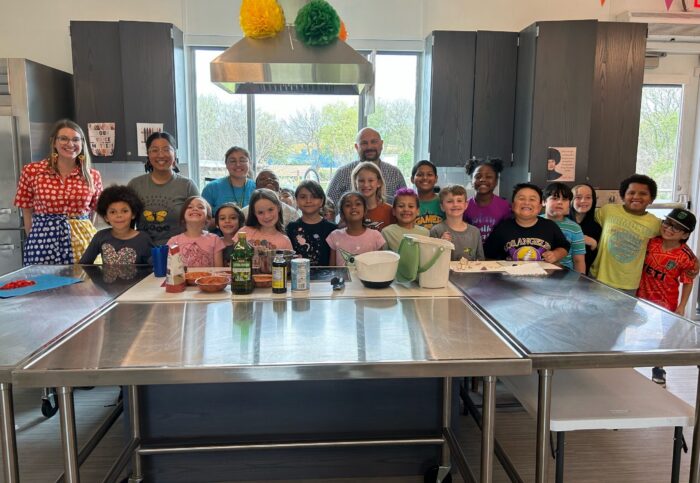
That belief is central to Emeril’s Culinary Garden & Teaching Kitchen, inspired by Chef Emeril and his wife Alden’s passion for helping young people and seeing the positive outcomes cooking and gardening education creates for children.
For Emeril Lagasse Foundation Chief Impact Officer, Katie Mularz, nearly a decade of helping shape and grow the program has reinforced an important lesson: food can be a powerful tool for helping children learn, connect, and discover what they’re capable of.
Katie brought a perspective shaped by experiences in child advocacy, food education, and working directly with schools. As a Court Appointed Special Advocate (CASA), she saw the importance of children feeling supported and having their basic needs met. Later, while volunteering at Holly Grove, a community garden in New Orleans, she saw how the right learning environment could bring out a different side of a student.
During a garden education class, Katie watched an elementary student who struggled in a traditional classroom become engaged, curious, and eager to learn.
“That was it for me,” Katie recalled. “I remember thinking, ‘This is really neat. How do we get this into more schools?’”
Her later work with KIPP New Orleans and USDA Farm to School helped answer part of the question. Working across classrooms, cafeterias, and nutrition education showed Katie how closely each piece needed to be connected.
“We can’t expect a child to suddenly want to eat healthier food if we’ve never given them an opportunity to learn about it,” Katie said. “When kids are part of growing a vegetable or preparing a meal, they’re much more willing to try it. They’re part of the process.”
Today, stories from Emeril’s Culinary Garden & Teaching Kitchen school communities continue to reinforce that idea.
Parents have shared stories of children who once avoided vegetables becoming excited to eat a salad after growing herbs and using them to make their own dressing at a family cooking event. Students have taken surplus lettuce and herbs they grew at school or at home and donated them to community refrigerators so others could enjoy what they had grown.
For Katie, moments like these demonstrate how lessons that begin with food can extend much further.
“When we hear about a student taking something they grew and sharing it with their community, that really stays with me,” Katie said. “They’re learning to think about other people, to give back, and to be a responsible member of their community. The lesson started in the garden, but it didn’t end there.”
The same principle applies to academics. In a garden or kitchen, concepts that can feel abstract in a traditional classroom become tangible. Students see measurement and math in a recipe, explore science through growing food, or experience history and culture by preparing a dish connected to a particular place or tradition.
Katie’s experience inside schools also helped shape another principle behind the program: a good idea is only as successful as a school’s ability to put it into practice.
“There are a lot of ideas that sound great on paper,” Katie said. “But a program has to work for the teachers, students, and schools actually using it. You have to understand how a school operates and build with that reality in mind.”
Emeril’s Culinary Garden & Teaching Kitchen was designed to accommodate school environments. Rather than operating as a standalone program, cooking and gardening experiences connect with classroom learning and the broader school experience. Flexibility in implementation allows school partners to integrate the program in ways that reflect their students, educators, culture, and priorities.
After nearly a decade of working alongside schools, the insights gained are informing how Emeril Lagasse Foundation thinks about the program’s next chapter. Not every school has the same resources or capacity, and the Foundation is exploring new ways to make food education accessible to more communities while preserving the elements that make the program meaningful.
Schools are an intentional place to focus the work. As cornerstones of their communities and places where children spend much of their day, schools offer a natural starting point. Increasingly, the Foundation is also seeing how lessons learned at school can extend beyond the school day.
Families have always been part of the vision, and in recent years, the Foundation and its school partners have created more opportunities for parents and caregivers to learn alongside their children. The stories coming back from families offer early signs of how experiences at school can influence what happens at home—and even within the broader community.
Now, Emeril Lagasse Foundation wants to better understand and measure those changes.
This year, the Foundation launched a longitudinal study examining how participation in Emeril’s Culinary Garden & Teaching Kitchen influences students’ attitudes toward healthy food, academic engagement, and overall well-being. The study is also helping the Foundation deepen family engagement and explore how learning at school carries into the home.
For years, stories from students, educators, and families have offered meaningful glimpses of what the program can make possible. The research represents an opportunity to build on that anecdotal evidence and better understand what changes, what lasts, and how those experiences shape children as they grow.
“We are working toward generational change,” Katie said. “That’s the ultimate goal.”